
On a recent earnings call, Sysco CEO Kevin Hourican noted a feature in the Sales Consultant-facing AI360 tool called Swap & Save:
"One of my favorite app capabilities within AI360 is something we call Swap & Save...if a customer has the opportunity to save the customer money, it prompts them in row one of AI360 - introduce the savings opportunity to your customer today.
It is having a tremendously positive impact and reaction from our sales colleagues. Our colleagues make more money when they sell those cases by putting it right in front of them, giving them confidence that it is a legitimate sub to that national brand product."
And earlier in the year:
"It has to do three things for it to be prompted. It has to save the customer money. It has to help make the Sales Consultants more money. And also, of course, it makes Sysco more money.
It has to hit all three. And when it hits all three, our SCs are excited about it because they make more money and they know they're saving the customer money as well."
B2B recommendation features usually miss the mark. Most B2B wholesale businesses do not have a particularly product-led approach to feature development, which instead often leads to an IT team implementing features pushed down by a waterfall-style decision framework. It's often centered around what leaders would like the customers to be doing rather than observations about the customers' actual behavior and needs.
Swap & Save has been the exception to that rule. Hourican's breakdown above is accurate - a win-win-win feature where the incentives of the customer, rep and business are fully aligned.
So...how did Sysco, of all companies, figure this out?
Think Like a Rep
Back in 2012 I was buying for the kitchen at Uchi in Houston, TX. I was working with a number of distributors including Hardie's Fresh Foods, a produce vendor and relationship we'd brought over from Austin, TX.
Moving there from Austin, I was mostly indifferent to who we used and received weekly visits from competing vendors in the area who wanted our produce business - Uchi was one of the best restaurants in town (and still is if my vote counts) and I managed about $3 million in food spend across produce, meat, dry goods, supplies, seafood and specialty goods.
After about a month, though, I told my boss we were not moving on from Hardie's - I had found a rep I couldn't give up. Greg from Hardie's was awesome and understood what I needed for the kitchen as well as any of my cooks - when he walked in I knew he wasn't there to waste my time, and he'd help me make the right call. I was 24 and still new to the culinary world, so having someone I could count on was critical.
A few months in Greg came in for dinner, and the next morning he knocked on the kitchen door. He'd noticed we were carrying microgreens as garnishes for some of the nigiri sushi pieces - "I'm not sure where you're buying them from, but we have daily trucks going to Uchi and I can get you a competitive price if you let me know what you're buying them for." A week later we pivoted to buying them from Hardie's.
As we continued to work together, Greg analyzed my buying habits and called out where he could get me better prices by buying cases instead of 5# packs, and bent over backwards more than once when I woke up Sunday to a depleted walk-in. Greg had spent years as a radio host, so even when I made utterly unreasonable requests to him, he knew how to stay in character - as my rep he was there to make sure our team got what we needed, and if he could do that then he had a right to make recommendations to try and grow his business.
Years later I founded Sous, a B2B Marketplace for restaurants and wholesale suppliers. I wanted to better understand what it was that made Greg so effective, so I called him back up. Greg's answer was straight to the point - be available, be friendly, don't waste time and bring recommendations that are actually worth discussing.
Don't Waste People's Time
I joined Sysco in 2022 and worked for three years as the Group Product Manager leading e-commerce. This meant recommendations, search, personalization, pricing, and the aforementioned Swap & Save initiative.
One of the first goals I was assigned echoed the same goal Kevin spoke about in the above earnings call - grow sales of the Sysco brand among Local customers. The previous efforts here had been blunt - banners, pop-ups, frequent interruptions in the ordering flow.
I thought about how Greg might have handled a similar goal from his boss - in my time as a chef I definitely grew comfortable cutting off reps who were wasting my time, but I'd never done so with Greg, even when he was obviously in sales mode.
Talking through examples with my team at Sysco, we reasoned that we needed above all else to find win-win moments for the customer - we wouldn't recommend something that didn't benefit the business, and we shouldn't expect the customer to buy something that didn't benefit their restaurant.
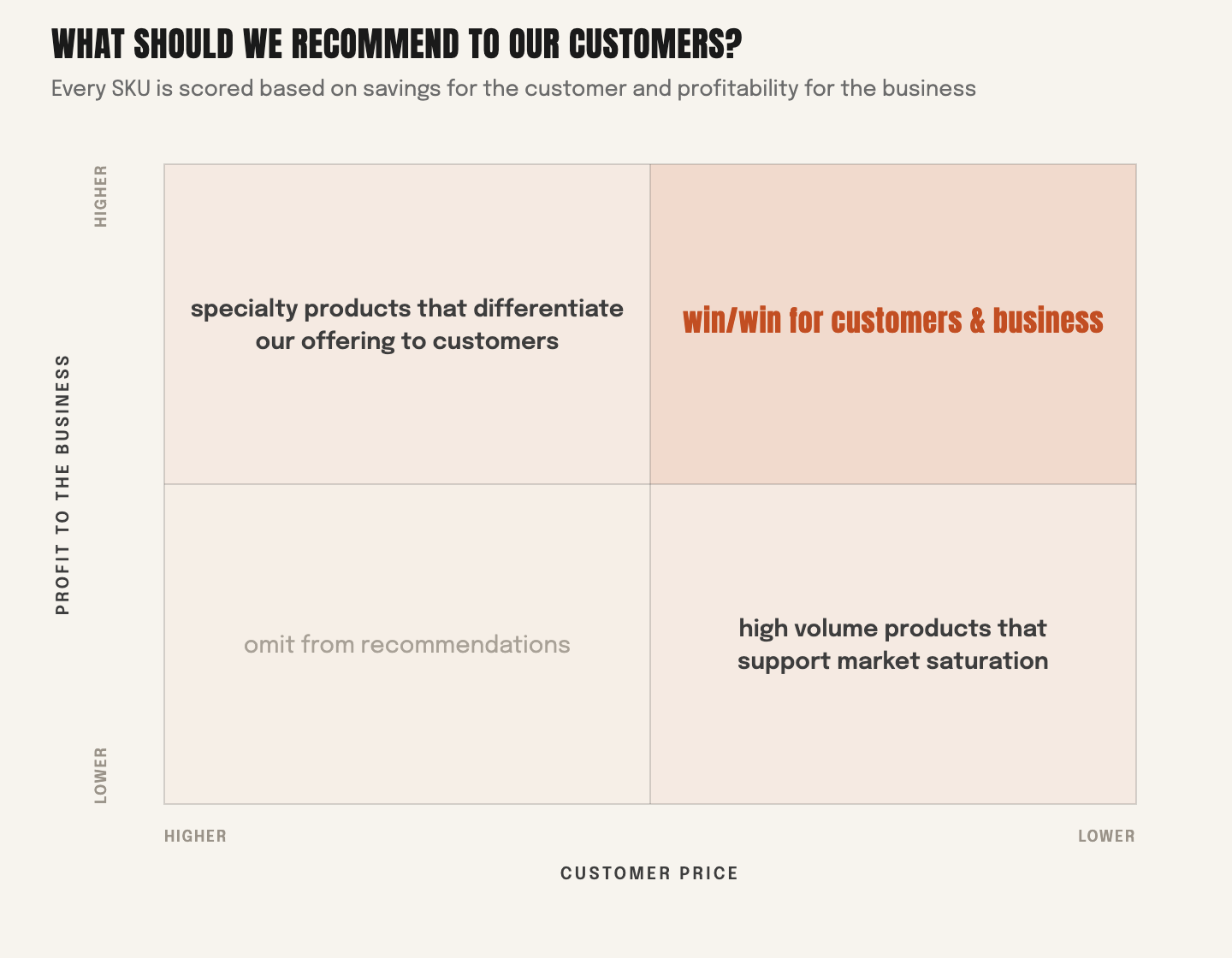
We settled on a basic e-commerce test - take roughly 200 items, identify strong matches for each item that accomplished Sysco's business goals, and make offers on them as alternatives to the customer only when the price benefitted the customer. In other words - only make an offer when we have a reason to believe we have value to offer them.
The Right to Win
The Right to Win is a framework that emphasizes finding opportunities in the market where your competitive positioning gives you better-than-average odds of winning.
It's not just having the right product though:
"You earn it by making a series of pragmatic choices that align your most distinctive and important capabilities with the way you approach your chosen customers, and with the discipline to offer only the products and services that fit."
Swap & Save is an example of this discipline in action. We saw outstanding engagement rates for the recs we knew were worth highlighting to customers, and when we tried to go beyond that set of offerings hoping the magic would stick, we saw the opposite.
Sysco has continued to develop this tool in the years since, and its longevity speaks to the impact of strong fundamentals - the foundational assumptions that go into a given product can outlast the first iterations of it, and nothing makes up for a product (or rep) that puts their customer's actual needs first.
- Start with what the customer needs from you and work to a solution from there - figure out where in the Venn diagram there is overlap between customer and business needs.
- Considering the "Right to Win" will tell you whether your customers have a reason to stop and consider your offer (whether via outside sales, e-commerce or marketing).
- When considering whether a recommendation is worth a customer's time, put on your sales hat and consider whether you'd actually be confident enough to call them to make the same offer. If no, move on.
- When building for restaurants - think back to the best sales reps you've ever had and consider why they were great (or ask your chef friends about their reps).
I write about what I'm seeing in the food supply chain, how operators can find success and where I think the industry is going.
You're on the list.Thanks for signing up!