
HotSchedules was the app that convinced me to get an iPhone in 2010. I had recently started as a busboy at Uchi in Austin, TX, and at the bar after work one day when someone said they got a notification that a shift was available at work, so they picked it up and celebrated finding a weekend shift. The whole interaction was revelatory - apps could be used for work.
The next five years saw a slow but steady adoption of mobile tech in restaurant operations, and in 2014 I took some sketches I'd drawn the year before and decided I wanted to do for back-of-house order management what HotSchedules had done for scheduling.
Sous was the first mobile wholesale ordering platform for restaurants, and we released it at a time when even email adoption was still low among operators - chefs took a clipboard, called their rep to leave a message, and that's the way it would be.
Until it wasn't - by 2022, Sysco, US Foods, Baldor and more were reporting that the majority of their orders were coming through e-commerce portals. From Sysco's 2021 Investor Day report:
"With more than $29 billion in annualized sales...70% of our independent customers in the U.S. [are] using this platform"
That number is only continuing to rise, with US Foods citing 84% adoption in 2024 and companies like Pepper chasing the longtail.
This may or may not be the top of the current e-commerce wave, though, as we're currently seeing the start of one adoption cycle and the tail end of another.
Hybrid Corn, Price and the Adoption Curve
Crossing the Chasm by Geoffrey Moore builds on an (appropriately for this post) unexpected source: Iowa State research into the adoption of new hybrid corn variants in the 1940s.
Moore's adoption curve builds on this idea, defining the cycle of technology adoption as following a similar pattern:
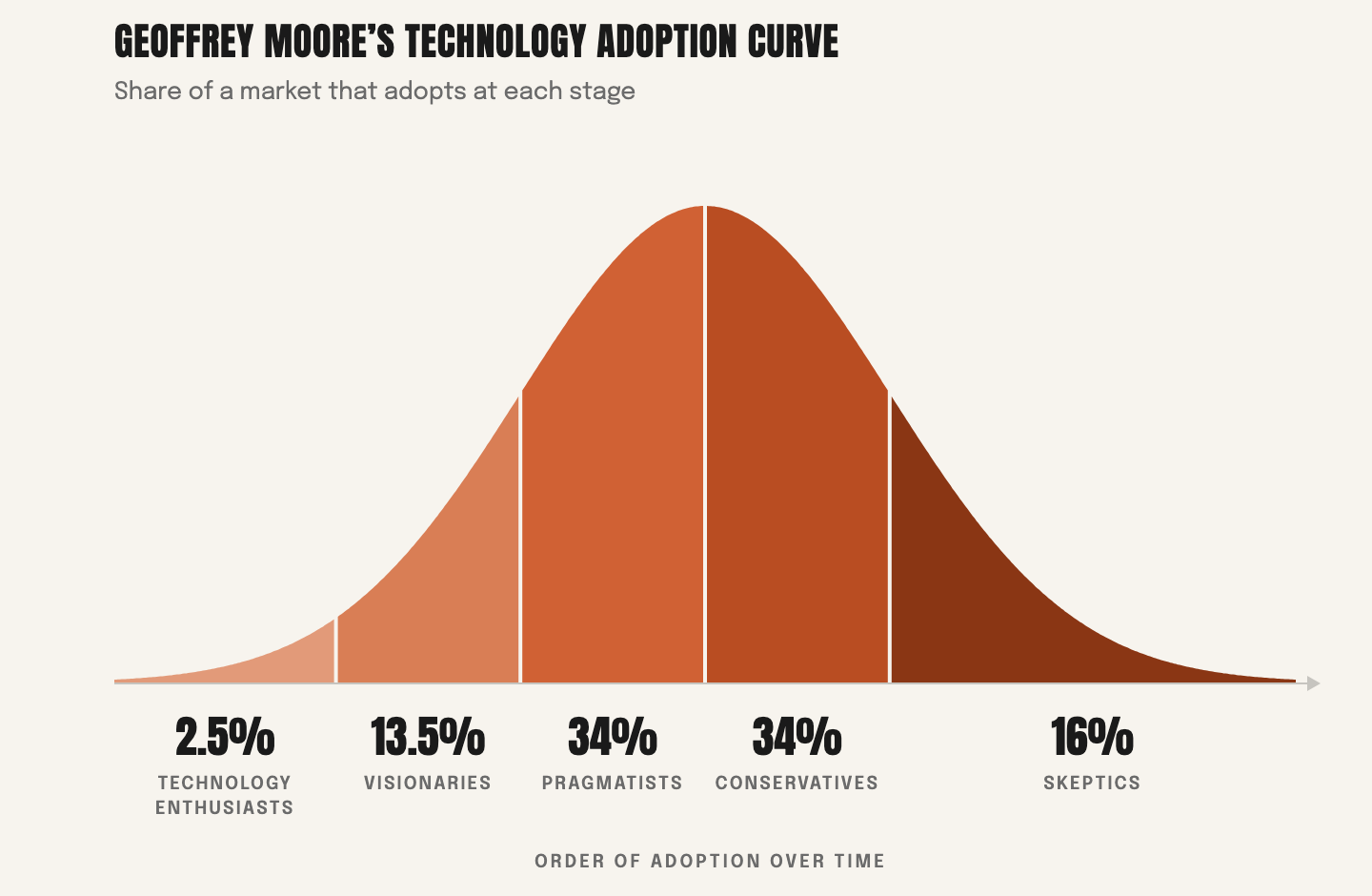
In it he argues there are distinctly different motivations driving technology adoption in the enterprise:
"The first perspective to set on pricing is the customers’, and, as we noted in the section on discovering the chasm, that varies dramatically with their psychographics. Visionaries – the customers dominating the early market’s development – are relatively price-insensitive. Seeking a strategic leap forward, with an order-of-magnitude return on investment, they are convinced that any immediate costs are insignificant when compared with the end result.
Contrast the above with those later in the adoption curve:
At the other end of the market are the Conservatives. They want low pricing. They have waited a long time before buying the product – long enough for complete institutionalization of the whole product, and long enough for prices to have dropped to only a small margin above cost. This is their reward for buying late. They don’t get competitive advantage, but they do keep their out-of-pocket costs way down. This is cost-based pricing, something that will eventually emerge in any mainstream market, once all the other margin-justifying elements have been exhausted.
Spend two minutes on LinkedIn and you'll see the meme of how early you are to AI - "99% of people haven't coded anything, keep going!" And that's true, we're clearly on the early side of the AI adoption curve now, and adoption will increase as token cost decreases.
But we're also on the back end of the software adoption curve, which is finally arriving due to the ability for non-coders to deploy software. Distribution costs for software have been zero since at least the advent of the app store, but with the arrival of AI coding tools, the cost to develop it is now nearing zero as well - the days of "I'd build this app if I knew a developer" are gone.
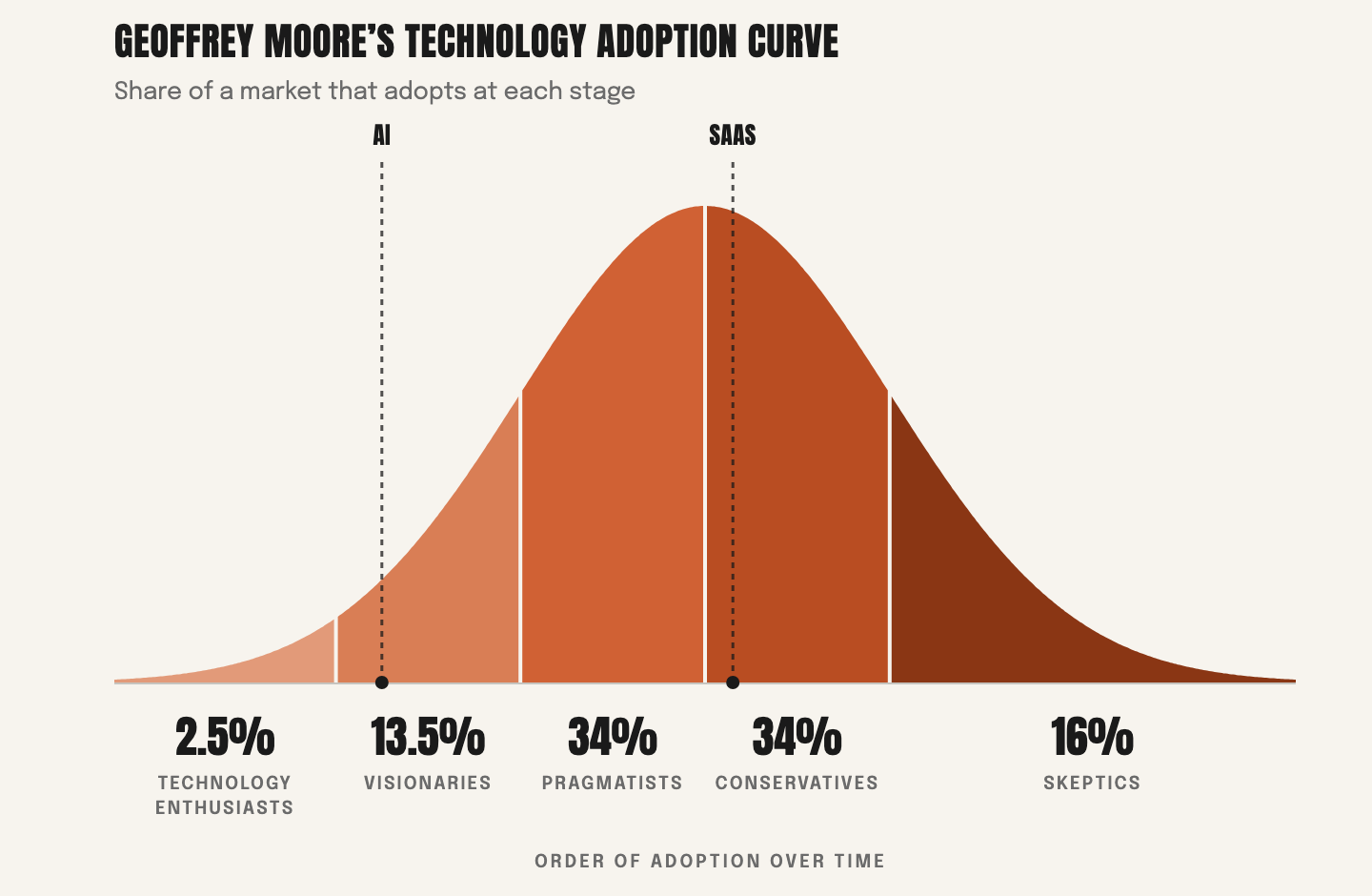
What does this mean for food producers and distributors? Custom enterprise software - the kind that occupied the "ask for pricing" tier on most pricing charts - is now available to all.
In 2027, I think the food distribution industry is going to see a massive wave of custom-built software solutions designed by sales reps, account managers, supply chain analysts, logistics planners, category managers and more. The tools are here, they're just not yet evenly distributed.
Not everyone is going to want to turn into a builder, but for those who are, it's exhilarating and extremely empowering. Here's what I think they're going to build:
Lightweight E-Commerce
Managing restaurant relationships as a distributor is all about meeting customers where they're at. You win by saying yes or having a product worth the extra price, work, or hassle.
Some customers never took to e-commerce tools - they just want to enter their order and be done with it. Searching and navigating a site can be tedious, and for the most part, today's e-commerce sites are adequate at best and overstuffed with unwanted recommendations at worst.
Even for those who took to e-commerce tools - restaurants also have AI coding tools. They will be able to vibe code their own ordering automation solutions that sidestep distributor tools if distributors are putting too much friction in place.
One solution - build for speed. A lightweight, truly interactive order guide for customers that makes you the easiest place for customers to get what they need. Allow sales reps to customize the tools for their customers. If customers want to monitor your prices to keep their competitors in check, add those items to the guide (they're going to do it to you anyway). Add flexible login options to make it extremely simple to use.
I've tested this approach out with a few customers and feedback has been strong. Now is the time to go on the offensive as a distributor and think about how easy you can make ordering for your customers.
Order Intake Agents
The other part of this is sales ops support for the team reading emails and listening to voicemails - the tech is there to transcribe these messages into a list of items, and depending on the size of your catalog/variance per order the step of entering these orders can be semi or fully automated.
This is something I've been pursuing since 2023 - if you have the customer's history, their known preferences and the context of the order, you can often get the order close to 100% right. This is still human-in-the-loop work, but even drafting the order for review rather than entering it from scratch each time is a massive win.
Data Abundance & 10x'd Personalization
Personalization for distributors has been a fairly limited solution to date. At best e-commerce sites are comfortable recommending what "customers like you" buy, disregarding whether or not that reflects any actual demand on a customer's menu. At worst, e-distributors often fall into the trap of recommending items customers were going to buy anyway - "you forgot to buy onions" is a useless recommendation if that customer was going to buy those onions later this week as they have every week for years.
Smart distributors are going to figure out how to maximize the use of their digital real estate. This means understanding what a good recommendation is, and that is directly downstream from the quality of your menu data on a given customer. Do you really understand what is on their menu? Are your reps able to go to them and make a strong pitch about items that are relevant to them?
All of this comes from menu knowledge, and a realistic goal for distributors today is to have a near-100% view of their customers' menu and opportunities. This menu data is parsed through predictive logic at the customer-facing menu, eg "Caesar Salad" on the menu implies Caesar dressing, which in turn implies a higher likelihood of lemons, anchovies and dijon mustard. These recommendations are then served to sales, marketing, e-commerce and more to improve the likelihood of success. Every menu from every customer should be regularly analyzed for new opportunities and the data collected should form the backbone of your CRM.
Automated Inventory & USDA / FDA Record-Keeping
I wrote about this here, but manual transcription is going to quickly be eliminated as more operators become comfortable with coding tools, set up their own intake systems and realize they can turn 5 hours of transcription into 5 minutes of auditing.
In particular - handoffs between different entities & vendors will benefit hugely from interoperability. Production reports today often arrive on a hand-written note listing weights, grades and output. Other times they're formatted differently, sometimes even shifting formats within the same vendor week to week. Standardizing the transcription and intake of this makes that information immediately available and speeds up the entire operational process, and these tools are ready today. I've written previously about the benefits of tracking this data using AI for USDA/FDA purposes as well - audits under this infrastructure should be a relatively simple exercise.
Prospect Identification & Opportunity Mapping
Similar to menu data awareness, building a funnel utilizing the abundance of data regarding potential customers will become table stakes for suppliers.
Trust is and will continue to be the biggest advantage in food distribution, but shortly behind that when acquiring new customers is speed to market and customer knowledge - is your rep the first person to knock on their door and start a conversation about price? Do you know what specifically the customer is looking for? Are you leading with a pitch that mirrors the brand image and offer the customer is building their business around?
This can get as granular as needed - sites like Eater and Time Out track new restaurant openings in major cities and should be tracked for opportunities. Public records from health inspection and real estate sites can give leading indicators to local reps. Government institutions announcing programs to prioritize specific diets or food supply chain goals will need a more sophisticated sales process, but can be excellent customers. Distributors should consider every potential customer and work to build a funnel that collects every possible signal (and the filtration to separate out the noise from the signal).
I'm certainly missing thousands of niche cases and other larger items - lot record management, inventory synchronization, automated billing and AR automation are all tools I've personally built that have had a huge impact, and we're still just scratching the surface. Whether it's newly enabled software solutions or agentic workflows, 2027 is shaping up to be a seismic shift in the way the food supply chain works.
- Anyone can code. Your frontline operators are going to be capable of building solutions that are 10x better than today's tooling (or more specifically, tools that are more relevant for their needs). Anticipate this and build systems that allow the team to keep up with a faster output.
- Data will be in abundance - menus, prospects, actions, preferences, responses, notes, etc. Build filtering systems to sort out the signal from the noise.
- Your competitors are building what you aren't - these tools are available for everyone, and customers are going to be loudly telling you what they want. There's a first-mover advantage for building better tooling for customers faster than the competition.
I write about what I'm seeing in the food supply chain, how operators can find success and where I think the industry is going.
You're on the list.Thanks for signing up!